Tuesday, June 28, 2011
The No Fear Approach to Manila
If you are interested in reading more about Manila, I encourage you to visit Here and There, a blog written by friends of ours who aren't afraid of polluted air and little things like flood waters. Enjoy!


Thursday, June 16, 2011
Bid List, Part II
The summer bid list is out! Let the obsessing begin!
My bidding strategy has dramatically changed since A-100. The 2nd tour bidding process, although still a directed tour, is different, but my thoughts, feelings, and priorities have also changed.
When we were bidding in A-100, I was inclined to overlook negative comments about posts on Real Post Reports and the OBC's Post Info To Go. In an attempt at worldwide availability, I wanted to be open to a variety of posts, and would try to read between the lines of an author's negative comments to get to the "facts" about a post. In theory, this is a sound way to distinguish reality from negativity, but it did not adequately take into account that I too will be subject to emotional responses while living at that post. If there is an overwhelming amount of negativity coming from a post, there may be a darn good reason it.
We FS folks are all, whether we like it or not, subject to worldwide availability, and bidding can be stressful because most of us want to know what we are getting into. In reality, you never, ever, truly know what you are getting into until you are in it. This goes for any major life change or decision, and life in the Foreign Service is a life of constant adaptation.
Because we don't choose our assignments, especially as an entry level FS family, it is necessary to work hard to approach this life with flexibility and an attitude of learning. But is it also necessary to be realistic, to know one's own limits, and to be aware that the expectations we bring to post can affect our ability to successfully adapt.
I was surprised by my own experience of cultural adaptation. It is generally thought that culture shock begins to wear off at 6 months following one's arrival, but I took much longer. I arrived at post with an open, positive mind and a desire to see the "real" Manila, but at 7 months the city--and perhaps my failure to acknowledge that I was experiencing culture shock--began to wear on me. A short time later, I had the opportunity to experience a 3rd world illness first hand--an "inevitable" experience of life in the Foreign Service. As someone who has always taken health very seriously, I was NOT ok with the inevitability of this experience. However, it taught me that MED is competent and has good drugs.
Having survived a year of illness, frustration, and culture shock, as we bid on our next post I hope I have learned things about myself and life in the FS that will help me adapt at our next post. I have learned that if a post is rated a 25% hardship, there's a reason for that, and it will serve me well to go into the experience of living there with appropriate expectations rather than a desire to overlook reality by being positive. I have learned that culture shock is not a weakness, but an inevitable aspect of life on the move. And finally, I have learned to be honest with myself about my limitations. Negativity doesn't help, but neither does naivete.
To all of you bidding on this summer 2011 cycle, I wish you luck and a good night's sleep!
My bidding strategy has dramatically changed since A-100. The 2nd tour bidding process, although still a directed tour, is different, but my thoughts, feelings, and priorities have also changed.
When we were bidding in A-100, I was inclined to overlook negative comments about posts on Real Post Reports and the OBC's Post Info To Go. In an attempt at worldwide availability, I wanted to be open to a variety of posts, and would try to read between the lines of an author's negative comments to get to the "facts" about a post. In theory, this is a sound way to distinguish reality from negativity, but it did not adequately take into account that I too will be subject to emotional responses while living at that post. If there is an overwhelming amount of negativity coming from a post, there may be a darn good reason it.
We FS folks are all, whether we like it or not, subject to worldwide availability, and bidding can be stressful because most of us want to know what we are getting into. In reality, you never, ever, truly know what you are getting into until you are in it. This goes for any major life change or decision, and life in the Foreign Service is a life of constant adaptation.
Because we don't choose our assignments, especially as an entry level FS family, it is necessary to work hard to approach this life with flexibility and an attitude of learning. But is it also necessary to be realistic, to know one's own limits, and to be aware that the expectations we bring to post can affect our ability to successfully adapt.
I was surprised by my own experience of cultural adaptation. It is generally thought that culture shock begins to wear off at 6 months following one's arrival, but I took much longer. I arrived at post with an open, positive mind and a desire to see the "real" Manila, but at 7 months the city--and perhaps my failure to acknowledge that I was experiencing culture shock--began to wear on me. A short time later, I had the opportunity to experience a 3rd world illness first hand--an "inevitable" experience of life in the Foreign Service. As someone who has always taken health very seriously, I was NOT ok with the inevitability of this experience. However, it taught me that MED is competent and has good drugs.
Having survived a year of illness, frustration, and culture shock, as we bid on our next post I hope I have learned things about myself and life in the FS that will help me adapt at our next post. I have learned that if a post is rated a 25% hardship, there's a reason for that, and it will serve me well to go into the experience of living there with appropriate expectations rather than a desire to overlook reality by being positive. I have learned that culture shock is not a weakness, but an inevitable aspect of life on the move. And finally, I have learned to be honest with myself about my limitations. Negativity doesn't help, but neither does naivete.
To all of you bidding on this summer 2011 cycle, I wish you luck and a good night's sleep!
Tuesday, June 14, 2011
Are we still in the Philippines?
Palawan still holds the title of my favorite place in the Philippines, but our recent trip to Baguio offered Palawan heavy competition.
In Northern Luzon, about 4-7 hours away from Manila (depending on traffic), a trip to the Ambassador's Residence in Baguio feels like a trip to another country. The air is clean and cool, and the air smells of ... pine trees!

Baguio was first developed around 1900 by Americans who were thrilled to have found mountains, pine trees, and cool air in the tropical climate of the Philippines. I can imagine their elation to have found a place that reminds us so much of home--even those of us from Florida! These pictures can't truly capture Baguio's sights, sounds, and most importantly, smells.

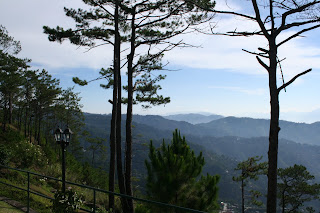

In Northern Luzon, about 4-7 hours away from Manila (depending on traffic), a trip to the Ambassador's Residence in Baguio feels like a trip to another country. The air is clean and cool, and the air smells of ... pine trees!

Baguio was first developed around 1900 by Americans who were thrilled to have found mountains, pine trees, and cool air in the tropical climate of the Philippines. I can imagine their elation to have found a place that reminds us so much of home--even those of us from Florida! These pictures can't truly capture Baguio's sights, sounds, and most importantly, smells.


An early morning view from the patio.

The back of the Ambassador's Residence.
US Embassy personnel are welcome to stay at the Ambassador's Residence for a small fee. Children are not allowed in the main residence building, but there are two cabins on campus that are great for families. There are plenty of restaurants in the City of Baguio, but I recommend bringing your own food, taking long walks, and enjoying your respite in the mountains!
For more information about the Residence's history, please visit the US Embassy Website at http://manila.usembassy.gov/wwwhamb1.html.
Wednesday, April 27, 2011
FS Spouses and Partners: It's FLO Fellowship application time again!
The State Department is pleased to announce the FLO Professional Development Fellowship program open to spouses and partners of direct-hire US Government employees under Chief of Mission Authority. This program is designed to assist those spouses and partners who are not in a position to pursue their career paths overseas to maintain, enhance, and/or develop their professional skills.
Proposals are due in M/DGHR/FLO no later than May 15, 2011.
Proposals are due in M/DGHR/FLO no later than May 15, 2011.
Palawan Holiday
Our recent trip to Palawan, an outlying island province in the Philipinnes, may havebeen my favorite domestic trip thus far. Palawan is well known for its diving and world class El Nido Resorts in the north, but central Palawan has a lot to offer as well.

We flew into Puerto Princesa and took a two hour van ride through the mountains to get to our resort near the Underground River, a UNESCO World Heritage Site and a must see for any trip to Central Palawan.
Sabang's unspoiled beaches surrounded by mountains are reminiscent of Hawaii, but since the Philippines has not made it onto Western tourists' radar, these beaches are undeveloped and unspoiled.


Palawan is the long, skinny island far to the left nearly touching Malaysia
We flew into Puerto Princesa and took a two hour van ride through the mountains to get to our resort near the Underground River, a UNESCO World Heritage Site and a must see for any trip to Central Palawan.
Sabang's unspoiled beaches surrounded by mountains are reminiscent of Hawaii, but since the Philippines has not made it onto Western tourists' radar, these beaches are undeveloped and unspoiled.

Sabang Beach
You can take a day tour from Puerto Princessa to the Underground River, but I recommend staying in Sabang. The mountainous, somewhat maintained road from the city to the Underground River area is an exhausting drive. Your hotel can book your tour and make sure you have the necessary permits--do not drive yourself to Sabang without these permits, as you will have to return to Puerto Princessa to get a permit before being allowed to participate in any of the activities.
The Underground River is incredible, although the boats they send you out in are small and ride awfully low. Once you get over worrying about falling in the water you can appreciate the wonders of the cave. The bats will not hurt you, but they fly low, so be prepared.


Emerging from the cave
The Underground River Park also has monitor lizards and monkeys. You can hike from Sabang to the Park on the Monkey Trail--technically this requires another permit.

From Sabang Beach you can hike along the coast on the rocks. The contrast of the colors of the rocks and the clear tropical water is beautiful, but the terrain is slippery and sharp.


For a lazy day, our resort offers Carabao cart rides. We didn't take a ride, but we did enjoy watching the baby carabao who wanders the grounds. He stays close to his tethered mama.

Wonderful snorkeling sites are approximately a 45 minute boat ride from Sabang Beach, and have different coral from the reefs close to Manila.
I recommend Daluyon Resort for its location and great food/food service, but not for its lack of hot water. The resort boasts of having solar water heaters and dismisses all hot water failures as a unavoidable part of being eco-friendly, but in doing so they are doing the environment a disservice. We installed a solar water heater in our house in Florida, and enjoyed hot showers every day.
Wednesday, April 20, 2011
Holy Week in the Philipinnes
In the US the year-end holiday season incorporates a variety of religious holidays and also celebrates the changing of the year. The Holidays are celebrated by Americans of all faiths for the season's abundance of parties, gifts, food, and a few days off from work. Despite being a predominantly Catholic country, the same is true for the Philippines. In fact, I felt that the culture of Christmas gift giving was even more pressured here than in the US.
This week is Holy Week, and my first experience of a nationwide religious celebration. Last Sunday the streets were filled with vendors selling palm fronds, and Maundy Thursday and Good Friday are non-working holidays honored by nearly all businesses. In contrast, many working Filipinos do not have Christmas Day off. My driver is celebrating his four day weekend by taking a family trip to his home province, and it is very rare that his adult daughter and son, who work in a call center and a mall, respectively, get time off from work.
Holy Week in the Philippines is known for its Good Friday processionals that feature penitents engaging in self-flagellation and, in Pampanga, crucifixion. Locals and Wikipedia tell me that such practices are strongly discouraged by the Church, but those who practice self-flagellation view it as a form of devout worship. My driver tells me that the person selected to be crucified in Pampanga campaigns to be chosen, and is usually someone who believes that he has sinned and needs to be reborn in his devotion to Jesus. The crucifixion lasts for about an hour, and is hopefully carried out by someone with darn good aim. The Philippine Department of Health encourages tetanus shots.


This week is Holy Week, and my first experience of a nationwide religious celebration. Last Sunday the streets were filled with vendors selling palm fronds, and Maundy Thursday and Good Friday are non-working holidays honored by nearly all businesses. In contrast, many working Filipinos do not have Christmas Day off. My driver is celebrating his four day weekend by taking a family trip to his home province, and it is very rare that his adult daughter and son, who work in a call center and a mall, respectively, get time off from work.
Holy Week in the Philippines is known for its Good Friday processionals that feature penitents engaging in self-flagellation and, in Pampanga, crucifixion. Locals and Wikipedia tell me that such practices are strongly discouraged by the Church, but those who practice self-flagellation view it as a form of devout worship. My driver tells me that the person selected to be crucified in Pampanga campaigns to be chosen, and is usually someone who believes that he has sinned and needs to be reborn in his devotion to Jesus. The crucifixion lasts for about an hour, and is hopefully carried out by someone with darn good aim. The Philippine Department of Health encourages tetanus shots.
A 2006 devotional crucifixion in Pampanga

In Manila, the city shuts down on Thursday and Friday, the radio stations suspend regular programming, and many people leave town. I've heard that there will be several processionals here in town. The processionals are bloody affairs, as you can see for yourself if you Google images of Holy Week in the Philippines.
I don't anticipate being anywhere near a crucifixion, but I am finding this experience interesting. Like many other cultural experiences in the Philippines, Holy Week feels familiar, and yet so different from my experiences in the US.
Wednesday, April 13, 2011
Culture Shock 101 (Duh)
As a new Foreign Service spouse I expected to be mostly adjusted to post six-seven months into my tour. As a clinical social worker, I should have known better. There is no chart; no timeline that you can fit yourself into perfectly. Knowing generally what to expect in a foreign country and educating oneself about adapting to change can help, but it won't necessarily make the process easier.
Before arriving at post I bought the book Culture Shock! and attended Tagalog classes at FSI, and from these resources felt somewhat prepared for what I would find in the Philippines. In my first few months I remember referencing what I had learned, but around December apparently forgot everything. It is only very recently that I have been able to shake off my bewildered frustration enough to be able to see what is happening to me--so this is culture shock! (Duh.)
Newcomers to the US Embassy are told that English-speaking Westerners get themselves in trouble because because Philippine social interaction is familiar on a superficial level. Even armed with this warning, it's easy to assume that you are able to communicate when you are both speaking English. ASSume nothing.
Even those of us with the best intentions can be overwhelmed by the emotional burden of living in a culture that is deeply different from one's own, and one of the reasons I joined the Foreign Service was for the learning experiences. Seven months later, I'm hitting the books--again, and because I have a point of reference, am learning much more from my reading. Expat survival guides such as Culture Shock! can be helpful in normalizing one's expat experience, but cannot help one avoid culture shock.
My personal guidelines for the rest of my tour in Manila:
1) Be indirectly clear, and clearly indirect. Do not expect to "talk it out."
2) There is no queue.
3) There is no privacy.
4) "Yes" = maybe, sometimes, I don't know, I don't care, I have no idea what you just said, and sometimes ... yes!
5) My expectations are appropriate for life on the other side of the planet. (Duh.) Let the little things go.

Before arriving at post I bought the book Culture Shock! and attended Tagalog classes at FSI, and from these resources felt somewhat prepared for what I would find in the Philippines. In my first few months I remember referencing what I had learned, but around December apparently forgot everything. It is only very recently that I have been able to shake off my bewildered frustration enough to be able to see what is happening to me--so this is culture shock! (Duh.)
Newcomers to the US Embassy are told that English-speaking Westerners get themselves in trouble because because Philippine social interaction is familiar on a superficial level. Even armed with this warning, it's easy to assume that you are able to communicate when you are both speaking English. ASSume nothing.
Even those of us with the best intentions can be overwhelmed by the emotional burden of living in a culture that is deeply different from one's own, and one of the reasons I joined the Foreign Service was for the learning experiences. Seven months later, I'm hitting the books--again, and because I have a point of reference, am learning much more from my reading. Expat survival guides such as Culture Shock! can be helpful in normalizing one's expat experience, but cannot help one avoid culture shock.
My personal guidelines for the rest of my tour in Manila:
1) Be indirectly clear, and clearly indirect. Do not expect to "talk it out."
2) There is no queue.
3) There is no privacy.
4) "Yes" = maybe, sometimes, I don't know, I don't care, I have no idea what you just said, and sometimes ... yes!
5) My expectations are appropriate for life on the other side of the planet. (Duh.) Let the little things go.

Subscribe to:
Posts (Atom)